On the Smooth Relationship Between Taxis and Buses
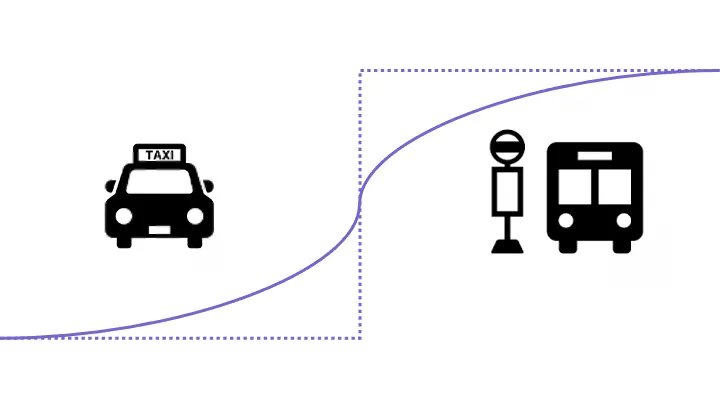
NearMe’s ridesharing shuttle provides a third transportation option between taxis and buses. Taxis are highly convenient for users, but because they can carry only a small number of passengers, dispatch efficiency is low and fares are high. Buses are the opposite. In this article, I explain the main parameters used in ridesharing shuttles, show that one extreme becomes taxi-like while the other becomes bus-like, and discuss how we can connect the two smoothly.
Acceptable Detour Factor
The acceptable detour factor defines how much longer a ride may become due to ridesharing, relative to the direct ride time. For example, assume an order from Tokyo Station to Haneda Airport takes 30 minutes when ridden alone. If the acceptable detour factor is 1.5, then a detour up to 30 x 1.5 = 45 minutes is allowed. If this rider is matched with an order from Roppongi to Haneda Airport, the route might become Tokyo Station -> Roppongi -> Haneda Airport, taking 40 minutes total. In that case, 40 < 45, so the match is feasible. If instead the rider is matched with an order from Shinjuku to Haneda Airport, the route might become Tokyo Station -> Shinjuku -> Haneda Airport, taking 50 minutes total. This time, 50 > 45, so the match is not feasible.
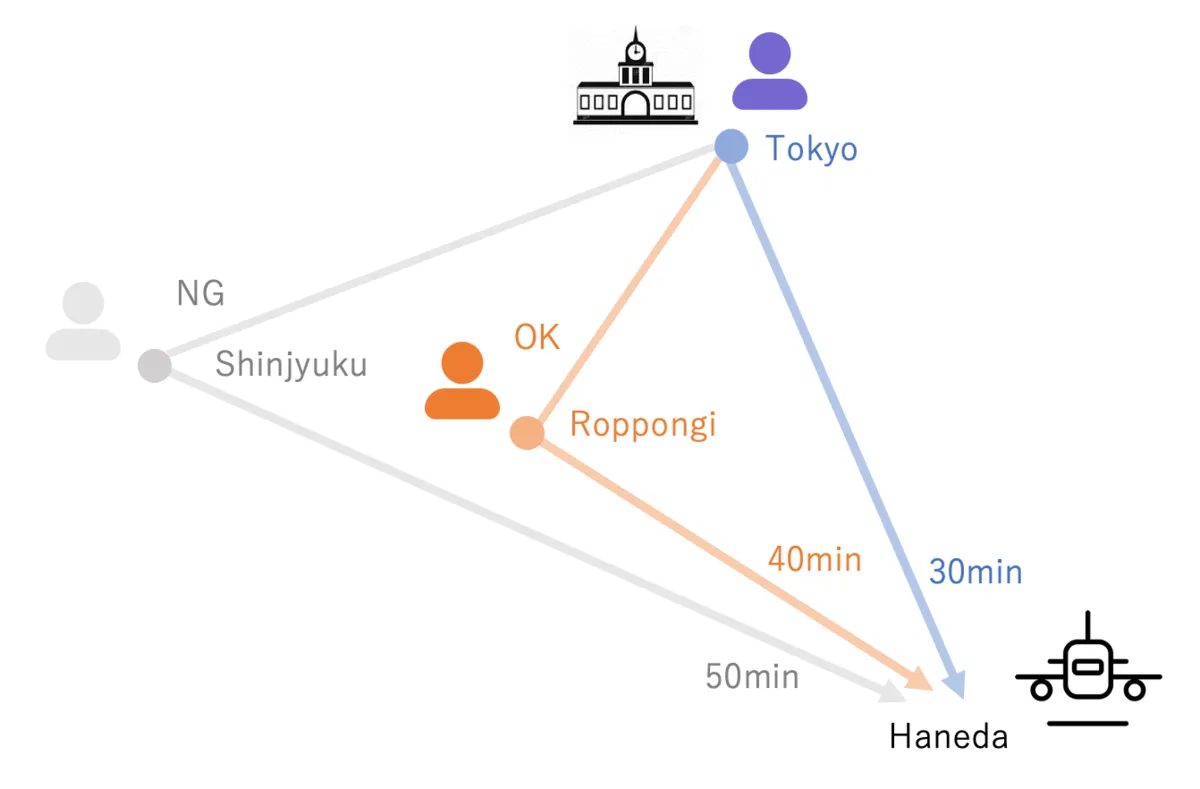
For taxis, which follow the shortest path, this factor is 1. For buses, which can take substantial detours, this factor becomes much larger. In ridesharing shuttles, this value differs by service type, such as airport transfer, urban mobility, or commuting. By balancing how much detour users can tolerate against how many vehicles we can provide, we can tune the service toward more taxi-like usage or more bus-like usage.
Acceptable Waiting Time
NearMe’s ridesharing shuttle allows users to choose either a requested departure time or a requested arrival time. Behind the scenes, we set an acceptable waiting time, so the final departure/arrival time may shift from the requested one. For example, if a user requests departure at 10:00 and the acceptable waiting time is 20 minutes, the actual departure time can fall between 10:00 and 10:20. If a user requests arrival at 11:00 and the acceptable waiting time is 20 minutes, the actual arrival time can fall between 10:40 and 11:00.
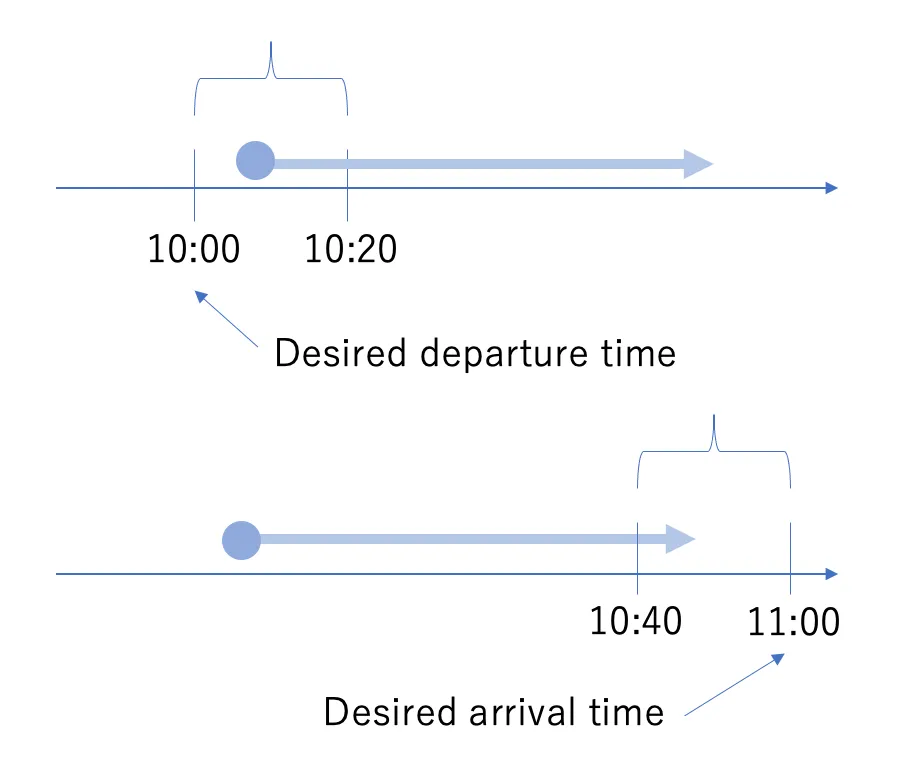
Without ridesharing, the departure or arrival time is exactly as requested. When ridesharing occurs, the time can shift so that everyone’s time constraints are satisfied. How much shift is tolerated is the acceptable waiting time. Increasing this value improves matching rates, but also introduces inconvenience for users.
For taxis, where ridesharing does not occur, acceptable waiting time is 0. For buses, this corresponds to the headway between services, which is generally larger. In ridesharing shuttles, this parameter is also adjusted by service type. At NearMe, we keep it shorter for urban use and longer for long-distance trips such as airport transfers. It can also be personalized per user (for example, “arriving sometime in the morning is fine”) and adjusted by time of day.
Maximum Passenger Capacity
Another parameter that affects dispatch efficiency is maximum passenger capacity per vehicle. For taxis, this is around three passengers; for buses, it can be several dozen. For ridesharing shuttles, six to nine seats are common.
In ridesharing, however, pickups and drop-offs are interleaved as shown below, so the constraint applies not to the total number of passengers over the whole trip, but to the peak onboard count at any point in the sequence.
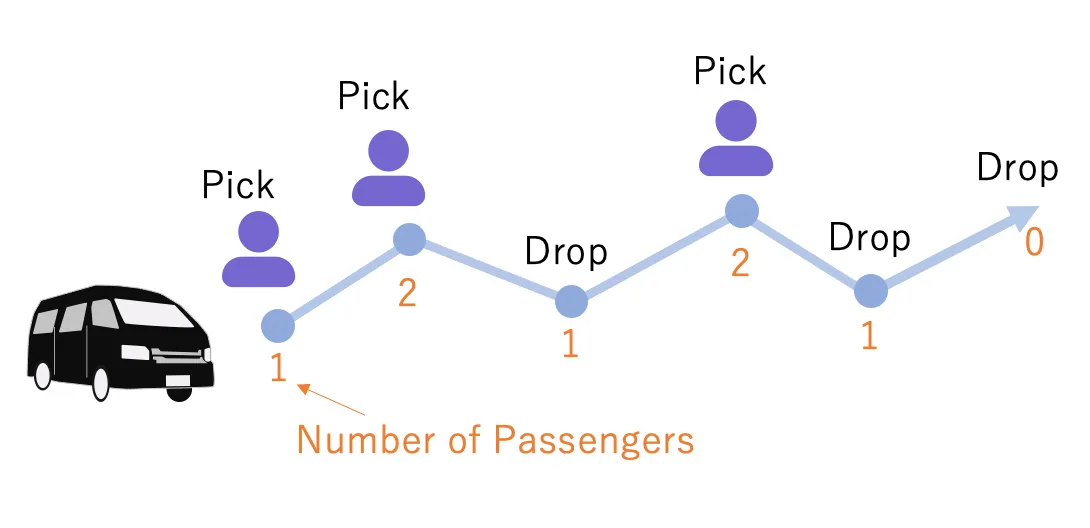
From a user convenience perspective, fewer onboard passengers, like in a taxi, are usually more comfortable. From a dispatch efficiency perspective, carrying more passengers is better.
On the other hand, buses can be inefficient when only a few people ride in a large-capacity vehicle. Choosing an appropriate vehicle size can improve efficiency. In practice, NearMe’s ridesharing shuttle can assign a properly sized vehicle later, and for some service types we increase maximum capacity and use larger vehicles such as minibuses.
Pickup Point Adjustment Distance
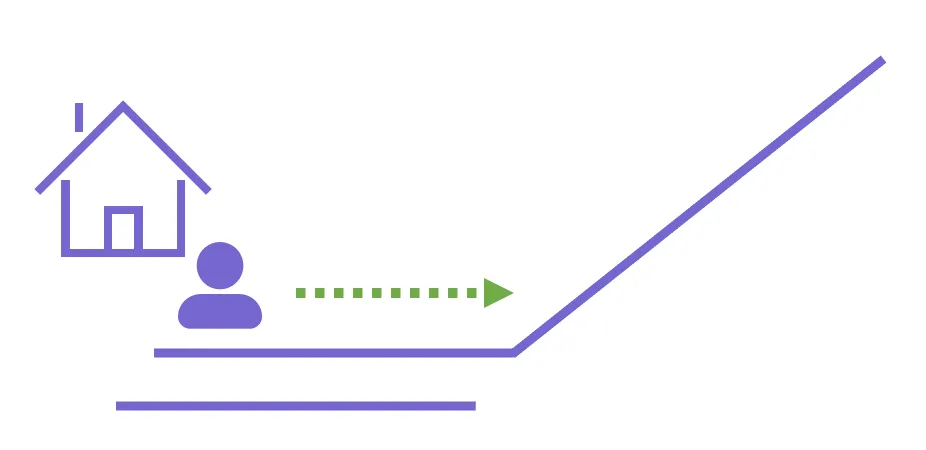
For taxis, pickup locations are arbitrary; for buses, stops are fixed. In ridesharing shuttles, pickup locations are basically flexible. However, because multiple riders are involved and smoother boarding is needed, we may adjust pickup points by asking riders to walk a short distance to places where vehicles can stop more easily, or by consolidating nearby riders into a common pickup point. Even so, this adjustment is typically much smaller than in bus operations.
Closing Thoughts
I explained the main parameters of ridesharing shuttles: acceptable detour factor, acceptable waiting time, maximum passenger capacity, and pickup point adjustment distance. Each parameter has a trade-off between dispatch efficiency and user convenience, and each can be adjusted continuously. By tuning these parameters flexibly according to service type, we can move along a spectrum whose extremes are taxis and buses. This flexibility allows us to offer a wider range of options tailored to user needs.
Finally, NearMe is hiring engineers! This domain still has a lot of untapped potential. If you are interested, please apply below.
Author: Kenji Hosoda